
Why Does a Car Have a Fault Code but No Symptoms?
A car can store a diagnostic fault code even when it drives normally because its onboard computer may detect an abnormal reading before the driver notices any change in performance. Some faults are intermittent, while others affect emissions, sensors or electronic systems without causing obvious symptoms.
A fault code does not automatically mean that the component named in the code needs replacing. It is a starting point for diagnosis. The correct next step is to interpret the code, check the vehicle’s history and carry out any relevant tests before deciding what repair is necessary.
What Is a Car Diagnostic Fault Code?
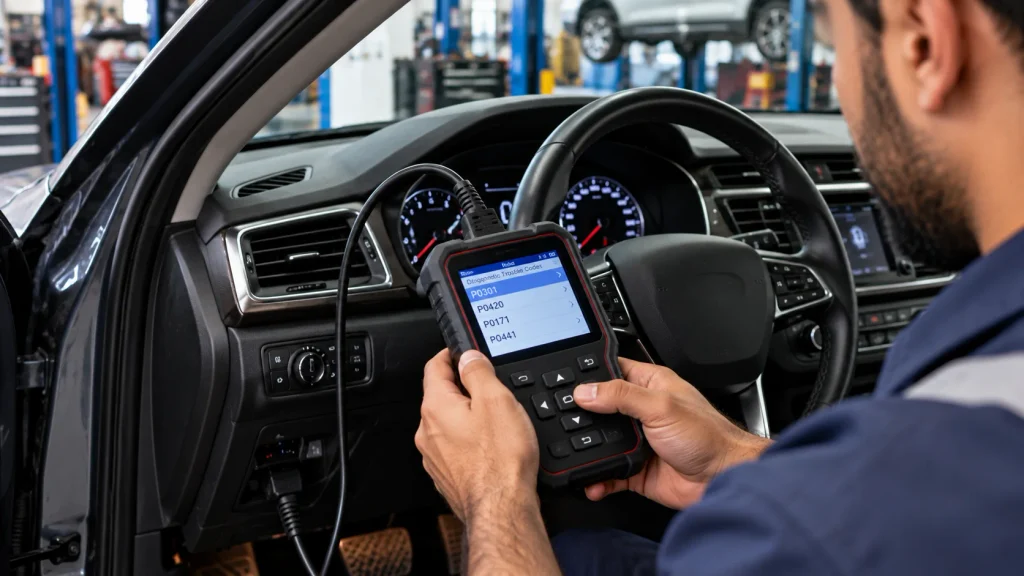
Modern vehicles use electronic control units (ECUs) to monitor and manage systems such as the engine, transmission and emissions controls. Depending on the vehicle, additional modules monitor braking, airbags, climate control and other functions.
When a monitored system detects a condition outside its expected operating range, it may store a diagnostic trouble code, commonly called a DTC.
A diagnostic scanner can retrieve available codes and related information. However, what the code tells you depends on the vehicle, the system involved and the diagnostic tool being used.
For example, a code may point towards:
- A sensor signal that is outside the expected range.
- An electrical circuit or connector problem.
- A misfire or emissions-related condition.
- An intermittent fault that is not present during the inspection.
- A system that requires further testing to confirm the cause.
The code provides useful evidence, but it does not always identify the exact failed part.
U.S. Environmental Protection Agency’s On-Board Diagnostics FAQs
Why Would a Fault Code Appear If the Car Feels Normal?
Several situations can explain why a diagnostic code exists without noticeable symptoms.
1. The fault is too minor to notice while driving
Some developing faults have little effect on how a vehicle feels. A sensor reading may occasionally fall outside its expected range without causing obvious hesitation, rough running or loss of power.
The absence of symptoms does not prove that the system is operating perfectly. Equally, a stored code alone does not prove that an expensive repair is necessary.
2. The problem happens intermittently
An intermittent fault may occur only under particular conditions, such as when the engine is cold, the vehicle is hot, the air conditioning is operating or the car is travelling at a certain speed.
By the time the vehicle reaches a workshop, the condition may have disappeared.
The stored code and any available operating data can help a technician understand when the fault occurred and what should be checked next.
3. A sensor or electrical connection is behaving inconsistently
A fault associated with a sensor does not necessarily mean that the sensor itself has failed.
Possible causes may include damaged wiring, a loose connector, a poor electrical connection, a supply-voltage problem or an issue elsewhere in the monitored system.
Replacing a component without checking the relevant circuit can leave the original problem unresolved.
Automotive Electrical Repair in Dubai
4. The fault affects emissions rather than everyday driving
Some engine-management faults can be detected before the driver notices a change in performance.
The engine may start normally and accelerate as usual, yet the onboard diagnostic system may have recorded a condition involving emissions monitoring or engine management.
That is one reason a car can appear healthy while still requiring further investigation.
U.S. Environmental Protection Agency guidance on OBD systems
5. The code is stored in the vehicle’s history
Not every code retrieved during a scan represents a fault that is actively occurring at that moment.
Depending on the vehicle and diagnostic system, the report may include current, pending, historical or permanent codes. Their meaning and status need to be interpreted correctly.
A historical code may relate to an earlier condition, while a pending code may indicate that a system has detected a problem that has not yet met all the conditions for a confirmed fault.
The important question is not simply whether a code exists. It is which code is present, what status it has and whether the underlying condition still exists.
Can You Keep Driving With a Fault Code but No Symptoms?
That depends on the code, the warning lights, the affected system and the vehicle manufacturer’s instructions.
If the car appears to drive normally, that is useful information, but it is not enough on its own to determine whether continued driving is safe.
Use these general guidelines:
| What you notice | Recommended response |
|---|---|
| Stored code, no warning light and no change in driving | Arrange appropriate diagnostic assessment; urgency depends on the code and vehicle |
| Steady check engine light with normal driving | Consult the owner’s manual and arrange a prompt assessment |
| Flashing check engine light | Reduce driving and stop safely; seek professional advice promptly because a serious misfire may damage the catalytic converter |
| Oil pressure warning, overheating warning or another critical warning | Stop safely and follow the vehicle manufacturer’s instructions |
| Loss of power, severe shaking, smoke, unusual burning smell or abnormal noises | Stop when safe and seek professional assistance |
These are general guidelines, not a substitute for the instructions specific to your vehicle. A warning light’s colour or appearance alone may not tell the full story.
Vehicle manufacturer’s owner manual or official warning-light guidance
What Should a Mechanic Check When There Are No Symptoms?
A proper diagnostic process should investigate the code rather than jump straight to a parts replacement.

Step 1: Identify the exact code
The technician should record the complete code, the system that reported it and its current status. The vehicle’s make, model, year, engine and specification can affect how a code should be interpreted.
Step 2: Review the available diagnostic information
Depending on the vehicle and the code, useful information may include freeze-frame data, live sensor readings, pending codes and related codes from other control modules.
This information can help establish the conditions under which the fault was recorded.
Step 3: Check the relevant system
The next checks depend on the evidence. They may involve inspecting wiring and connectors, testing electrical supply and ground connections, comparing sensor readings with manufacturer specifications or carrying out mechanical checks.
Not every vehicle or fault requires every test.
Step 4: Consider related faults and recent work
The technician may need to know whether the battery was recently replaced, the vehicle underwent repairs, a warning light appeared after servicing or the code has returned after being cleared.
These details can help narrow the investigation without assuming that the most obvious component is responsible.
Step 5: Confirm the cause before recommending a repair
Once the available evidence points to a likely cause, the technician can explain the findings and recommend the appropriate repair or further testing.
After authorised work is completed, the repair should be verified using checks appropriate to the original fault.
This evidence-based approach helps reduce unnecessary parts replacement and makes it easier for the vehicle owner to understand why a repair has been recommended.
Why Might a Fault Code Return After It Has Been Cleared?
Clearing a code removes diagnostic information from the vehicle’s memory where the system permits it; it does not repair the underlying fault.
If the original condition remains, the code may return when the relevant monitoring system detects it again. In some cases, the system needs particular driving conditions before it can complete its checks.
Clearing codes prematurely may also remove useful information that would have helped diagnose an intermittent problem.
If a code keeps returning, provide the workshop with the earlier scan report, any repair invoices and details of when the warning reappears.
Do not treat a warning light going out as proof that the fault has been fixed.
Why Is This Worth Checking in Dubai?
Dubai drivers may encounter long periods of stop-and-go traffic, high ambient temperatures and heavy use of air conditioning. These conditions can influence how some vehicle systems operate.
However, the weather should not automatically be blamed for a fault code. The actual cause must be established from the vehicle’s diagnostic information and relevant physical tests.
If a code appears after a long drive, during hot weather or while the air conditioning is running, tell the technician exactly when it happened. That context may help reproduce the fault or interpret the available data.
For drivers who need professional fault-finding, Car Diagnostics in Dubai explains the relevant service available from West Line Auto Repairs.
What Information Should You Give the Workshop?
Before arranging an inspection, make a note of:
- The exact fault code, if you have a scan report.
- Which warning light appeared, and whether it is steady or flashing.
- Whether the car starts, idles and drives normally.
- When the code appeared: at startup, in traffic, during acceleration or after a long drive.
- Any recent battery replacement, servicing or repair.
- Whether the code has been cleared before and returned.
You do not need to identify the failed component yourself. Accurate observations help the technician decide which checks are appropriate.
Frequently Asked Questions
Can a car have a fault code without the check engine light being on?
Yes. Depending on the vehicle and diagnostic system, a code may be stored or pending without the check engine light being illuminated. The code’s status and significance need to be checked for the specific vehicle.
Does a fault code mean a part is broken?
Not necessarily. A code may identify a monitored condition or circuit that needs investigation. The cause could be a component, wiring, a connection or another related issue. Further testing may be needed before recommending replacement.
Can a diagnostic scanner show a false fault?
A code can be misunderstood, may relate to an earlier condition or may require additional context. That is different from assuming the scanner has produced a false result. The code, vehicle information and supporting test results should be reviewed together.
Should I clear the code and see if it comes back?
It is better to record the code and relevant diagnostic information before clearing anything. Clearing it can remove useful evidence, and the fault may return only under specific conditions. Follow the vehicle manufacturer’s procedures or ask a qualified technician.
Can a fault code disappear on its own?
Some codes or warning conditions may no longer appear after the monitored condition stops occurring, depending on the vehicle and code type. That does not automatically establish that the original issue has been permanently resolved.
Is a basic OBD2 scan enough?
It may be enough to identify a straightforward issue, but coverage varies by scanner and vehicle. Some faults require manufacturer-specific access, live-data analysis or physical testing. A technician can determine whether further diagnosis is necessary.
How much does car fault-code diagnosis cost in Dubai?
The cost depends on the vehicle, the diagnostic equipment required and the depth of testing. Reading codes is not the same as tracing an intermittent electrical fault or testing a mechanical system. Ask the workshop what the quoted diagnostic fee includes before approving the work.
What if the car feels completely normal?
Record the code and arrange an assessment appropriate to the fault. Normal driving behaviour is reassuring, but it cannot establish the condition of every monitored system. If a critical warning appears or the vehicle develops unusual symptoms, follow the manufacturer’s safety instructions.
Final Thoughts
A car fault code without noticeable symptoms does not automatically mean that your vehicle needs an expensive repair. It also should not be dismissed simply because the car feels normal.
The useful next step is to understand the code, review the available information and carry out the checks needed to establish whether a genuine fault exists and what is causing it.
At West Line Auto Repairs in Dubai Investment Park 2, the principle is simple: we don’t guess, we test. If your vehicle has stored a fault code, a warning light or a recurring diagnostic issue, contact the workshop to discuss the appropriate diagnostic assessment before authorising unnecessary parts replacement.